Enterprise Workforce Governance API
A high-integrity, multi-tenant administrative API designed to enforce jurisdictional boundaries and verify high-risk personnel lifecycle mutations.
01. The Problem
Large-scale distributed organizations often suffer from 'Administrative Drift'—where localized management exceeds their jurisdictional authority. The challenge was to architect a zero-trust administrative layer that programmatically enforces regional boundaries and mandates multi-factor verification for irreversible personnel actions.
02. The Logic
Jurisdictional Authorization: Implemented logic-gated access control that restricts administrative scope to specific geographic or departmental nodes.
Verified Mutation Loops: Critical lifecycle changes (Termination, Suspension, Promotion) are protected by asynchronous, email-based OTP challenges.
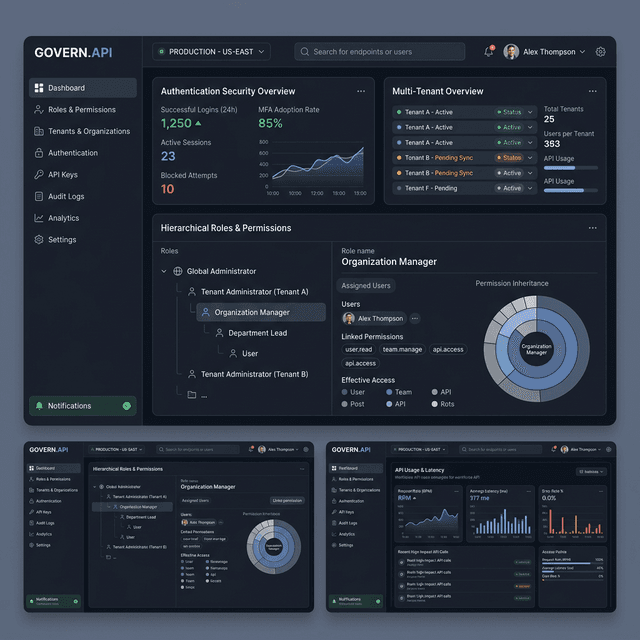
Hierarchical RBAC: A 4-tier permission architecture supporting granular inheritance from regional departments to global headquarters.
Cryptographic Resource Masking: Utilized reversible hash-encoding for internal resource IDs to prevent horizontal privilege escalation and resource enumeration.
Temporal Lifecycle Tracking: Automated calculation of eligibility milestones and retirement dates based on immutable hire-date logic.
03. The Stack
04. The Solution
Implementation Result
A rewritten, highly modular API built on NestJS that centralizes staff metadata into structured entities (Personal, Professional, Marital, etc.) while introducing a verification layer for all high-risk administrative operations.
Key Outcomes
- 01.Consolidated 15+ staff-related data models into a unified relational schema
- 02.Implemented a 4-tier hierarchical permission system covering regional and national jurisdictions
- 03.Achieved 100% verification coverage for staff termination and suspension workflows via OTP integration
Reflection
- Advanced NestJS module patterns for separating Auth, Staff, and Model concerns
- Handling complex database transactions across multiple dependent models in Sequelize
- Implementing security best practices like ID encoding and environment-driven TLS/SSL configurations for production databases